
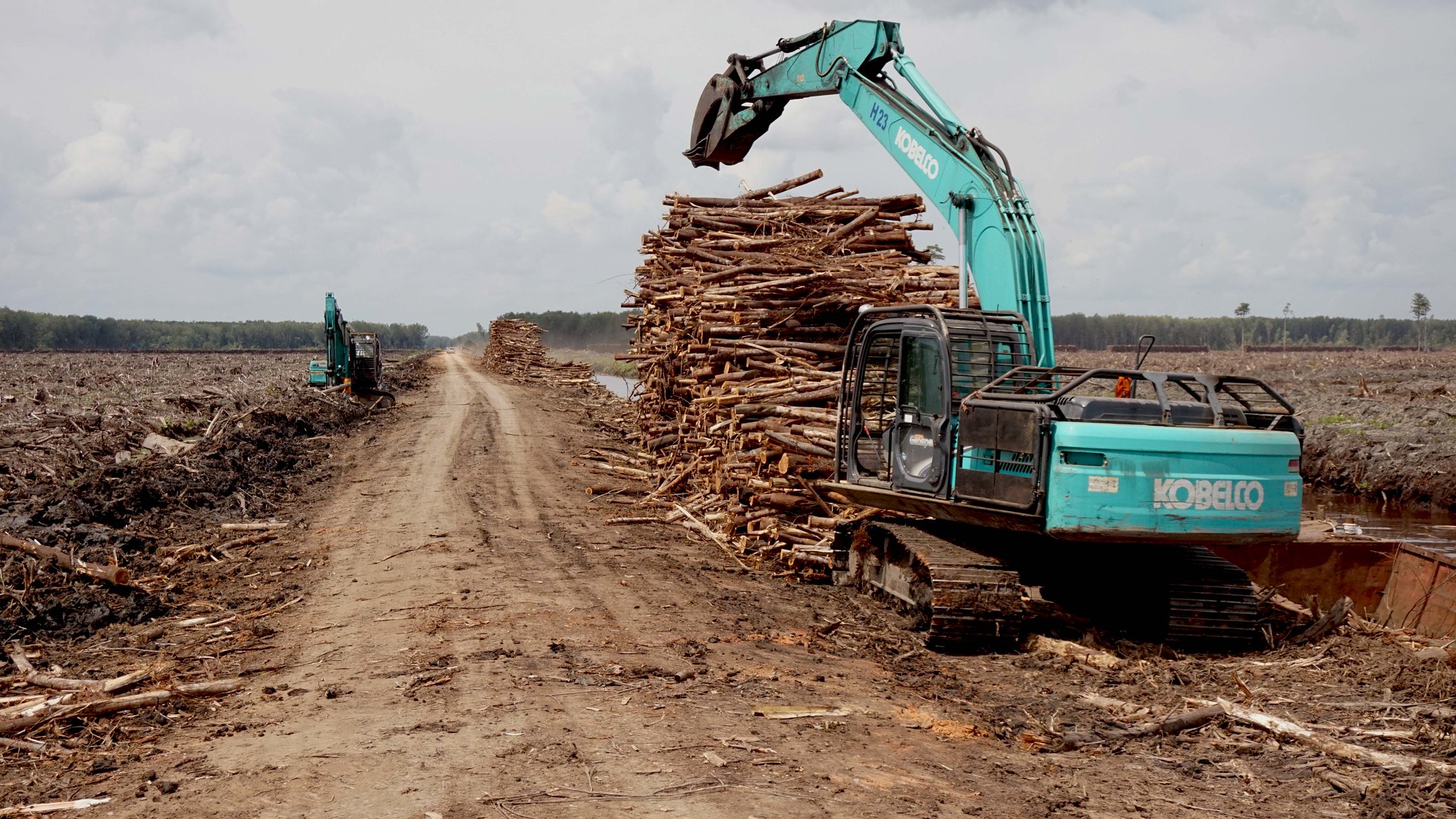
Forest-friendly sourcing from just seven companies could cut emissions equivalent to the Netherlands
Just by implementing zero-deforestation and peat-free sourcing, seven agricultural trading giants could make a major contribution to reducing global greenhouse gas emissions.
Oxford, United Kingdom (3 November 2025) – Trase analysis shows that JBS, Marfrig, Minerva, Musim Mas, Royal Golden Eagle, Sinar Mas and Wilmar have the potential to reduce global greenhouse gas emissions equivalent to the Netherlands' annual emissions.
The seven traders have the highest exposure to greenhouse gas emissions from land-use change linked to soft commodity exports. According to the data, in 2022, the companies were exposed to more than half of all deforestation and peat-related emissions linked to exports of beef from Brazil, and palm oil and wood pulp from Indonesia.
“This analysis shows that a handful of actors can deliver climate benefits larger than entire countries,” said André Vasconcelos, Global Engagement Lead at Trase. “It is crucial that the private sector steps up their actions in this collective effort to mitigate climate change.”
The emissions are primarily tied to the companies’ sourcing of beef from Brazil and palm oil and wood pulp from Indonesia. These commodities are often cultivated on recently deforested land or drained peatland, both of which release vast quantities of greenhouse gases. Exported palm oil and wood pulp from Indonesia have the heaviest climate footprint, with accumulated 191.2 Mt CO₂- eq, or 74% of the exposure to land-use change emissions.
“Indonesia plays a central role in this picture – both as one of the largest commodity producers and as a country bearing the environmental cost,” said Timer Manurung, Chair at Auriga Nusantara. “These companies have the power and the responsibility to transform the industry. Implementing genuine zero-deforestation and peat free supply chains would not only protect forests and peatlands but also strengthen Indonesia’s contribution to the global climate agenda.”
According to the latest Forest 500 assessment, all seven companies have made public zero-deforestation or zero-conversion commitments, but not all have publicly committed to report on
their progress. “It is great to see corporate commitments and actions, but without public disclosure and transparent reporting, there’s no way to verify whether their pledges are being met,” points out Vasconcelos.
The full report: https://trase.earth/insights/leveraging-supply-chains-for-climate-action-the-outsized-carbon-saving-potential-of-seven
Notes to Editors
For more information and to arrange an interview, contact: g.souzaneuls@globalcanopy.org
About Trase
Trase is a data-driven transparency initiative that maps the international trade of agricultural commodities, providing tools that enable companies, financial institutions and governments to address tropical deforestation. www.trase.earth
About Forest 500
Forest 500 identifies the companies and financial institutions with the greatest exposure to deforestation risk, and annually assesses them on the strength and implementation of their commitments on deforestation, conversion of natural ecosystems and associated human rights. The 11th annual Forest 500 assessments took place between April and September 2024.
About Auriga Nusantara
Auriga Nusantara is a non-governmental organization focused on promoting the conservation of natural resources and environmental balance to improve the quality of human life by eliminating destructive actions, which involves reducing the actions of individuals, groups, or companies that cause environmental damage and economic losses to the country. Since 2019, Auriga Nusantara has been a strategic partner of Trase.Earth in Indonesia.