
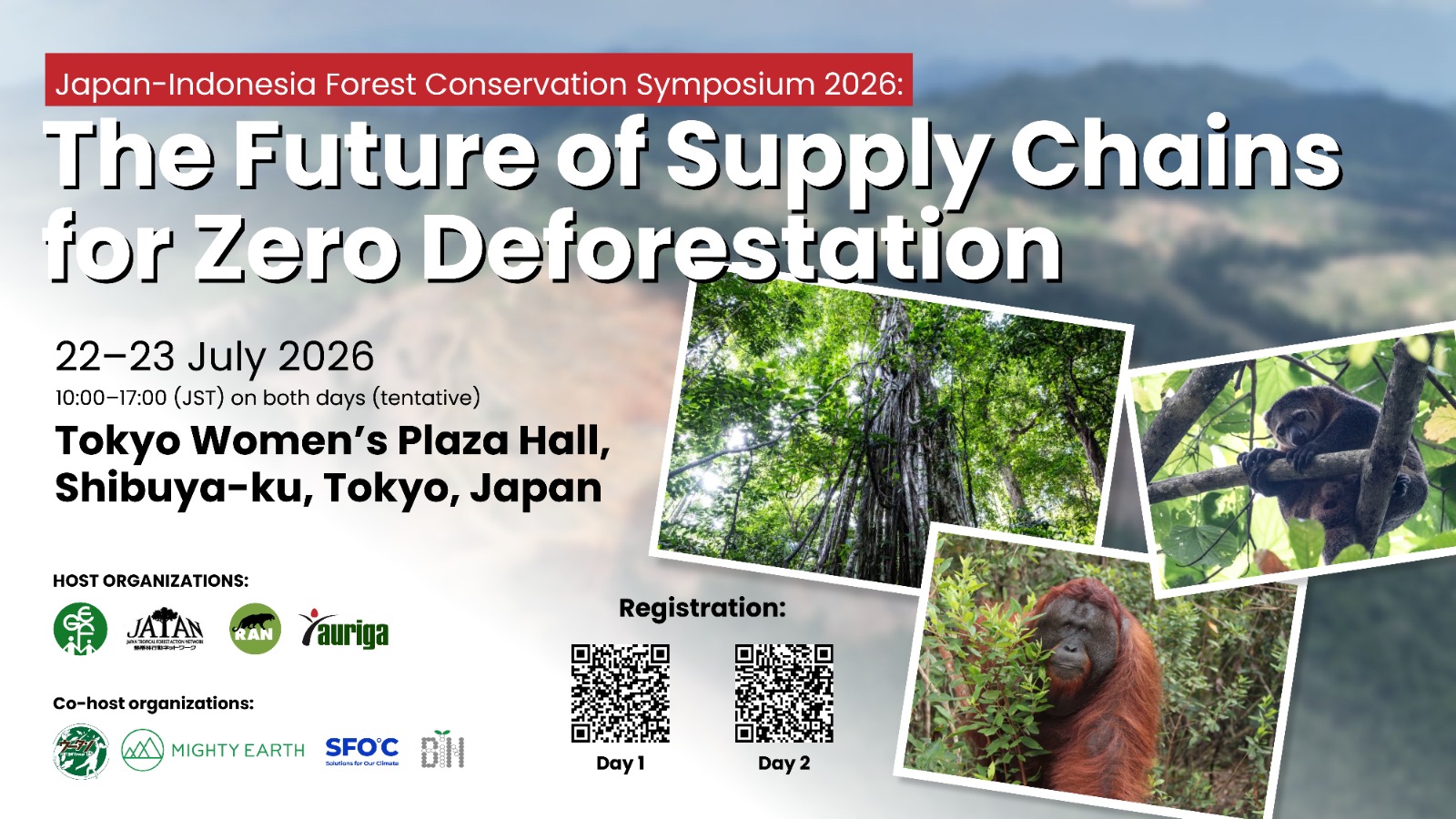
Japan-Indonesia Forest Conservation Symposium 2026: The Future of Supply Chains for Zero Deforestation
Indonesia is home to the world’s third-largest area of tropical forests and is known for its exceptionally rich biodiversity. Conserving the country’s forests is critically important not only for global climate action but also for biodiversity conservation. Nevertheless, the rapid deforestation has continued in recent years.
For decades, Japan has been a major consumer market for forest commodities from Indonesia, including timber, palm oil, and pulp and paper products. More recently, imports of wood pellets used for renewable energy generation have also increased rapidly. Japan has continuously depended on Indonesia’s forest resources.
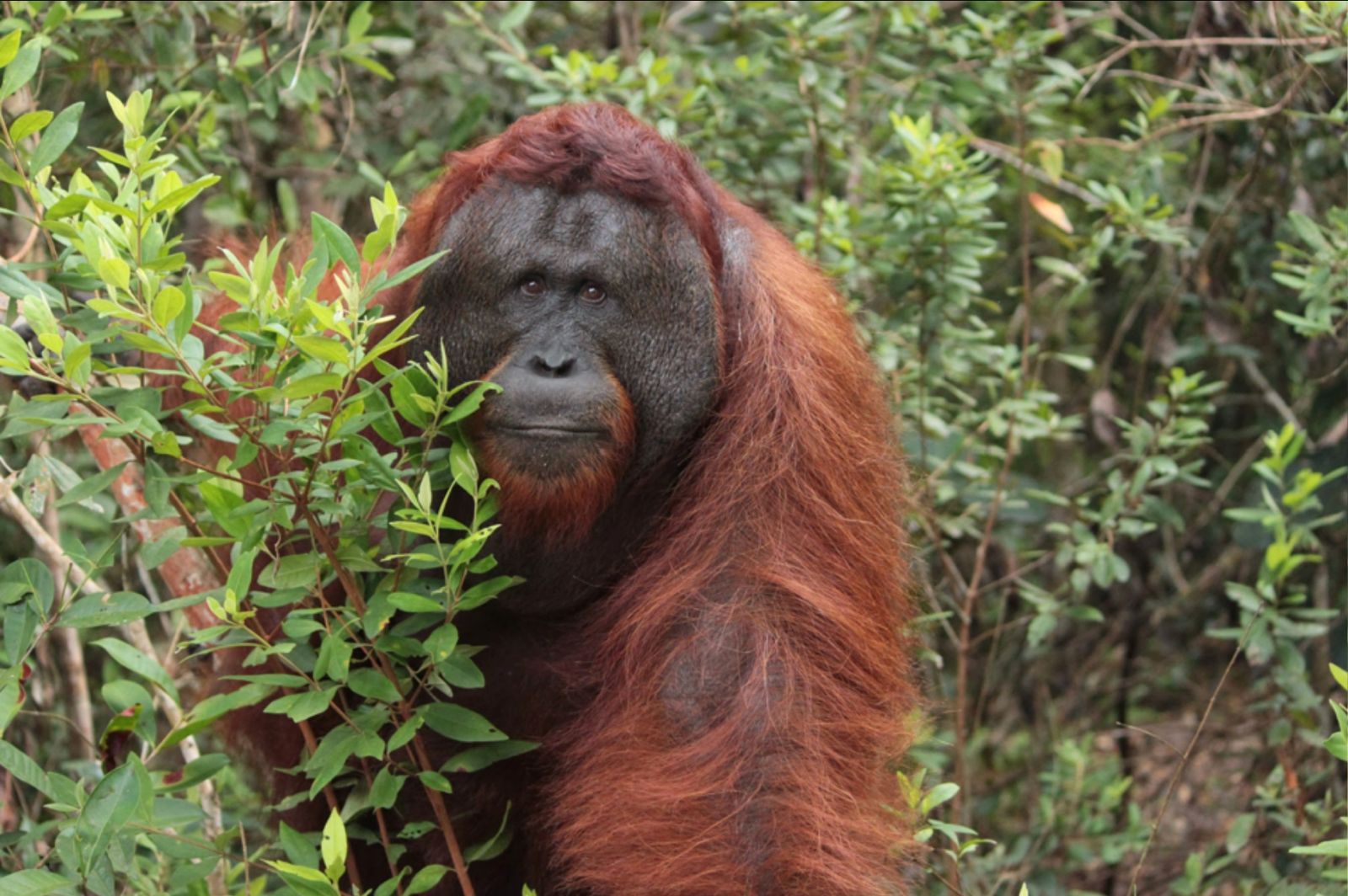
Borneo Orangutan (Pongo pygmaeus) © HUTAN Group
As a response to this discourse, Auriga Nusantara and Japan NGO partners ( (Global Environmental Forum - GEF, Japan Tropical Forest Action Network - JATAN, and Rainforest Action Network - RAN) collaborating with several organization partners hosting a symposium which serves as a place for multi-stakeholder dialogue, bringing together NGOs and researchers engaged in field-based research and policy advocacy on deforestation and forest conservation in Indonesia, as well as Japanese companies and investors working to achieve zero deforestation in their supply chains.

Bear Cuscus (Ailurops ursinus) ©Taishi Takahashi / GEF.
In each session, the speakers will share the latest information on deforestation, biodiversity risks, and impacts on local communities associated with the production of each forest-related commodity, while exploring the actions needed to address these challenges. It will also examine opportunities for collaboration to promote more effective forest and biodiversity conservation and explore pathways toward a nature-positive future that does not drive the loss of tropical forests.
DAY 1
10:00–13:15 | Session 1: Pulp dan Paper
Keynote Speech
Deforestation in Indonesia: Current Situation and Drivers (tentative)
(Commissioner, Indonesian National Commission on Human Rights)
Deforestation in Indonesia: Current Situation and Drivers (tentative)
(Commissioner, Indonesian National Commission on Human Rights)
Around 30% of the copy paper used in Japan is produced in Indonesia. Indonesian NGOs and researchers will present the environmental and social issues associated with pulp and paper production, including tropical deforestation, peatland development, and violations of the rights of Indigenous Peoples and local communities. A Japanese NGO will share its engagement with companies, as well as current practices and leading examples among Japanese paper users. Through perspectives from both producing and consuming countries, the session will explore the actions needed to promote responsible sourcing of paper products.
Moderator (Rainforest Action Network)
Speakers
- (HaKI/Our Forest Institute)
- (JATAN/Japan Tropical Forest Action Network)
- (WWF Indonesia)
- (Ajinomoto Co.)
14:30–17:00 (TBD) | Session 2: Palm Oil
Indonesia has become the world’s largest producer of palm oil, and vast areas of its tropical forests have been rapidly converted into oil palm plantations. Despite progress in sustainability initiatives, environmental and social issues associated with plantation expansion remain significant challenges. In this session, Indonesian NGOs will provide updates on the latest environmental and social impacts of oil palm plantation development. A Japanese NGO will present the current status and challenges of responsible palm oil sourcing among Japanese companies, drawing on more than a decade of survey research and corporate engagement. Representatives from companies that are advancing the development and implementation of NDPE (No Deforestation, No Peat, No Exploitation) policies, as well as investors actively engaging with companies on these issues, will share their experiences, perspectives, and approaches. The session will explore pathways toward deforestation-free supply chains.
Moderator (Graduate School of Agriculture, Kyoto University)
Speakers
- (Resona Asset Management)
- (Japan Tropical Forest Action Network)
- A relevant government agency officer in charge of biomass or a relevant committee member (TBC)
- (TRASE)
- (Sustainable District Association - LTKL)
Day 2
10:00–12:30 (TBD) | Session 3: Biomass
In Japan, biomass power generation is promoted and subsidized as a form of renewable energy, and imports of biomass fuel from Indonesia have increased rapidly in recent years. In the areas where these fuels are produced, large tracts of forest have been cleared, resulting in the loss of valuable ecosystems that support endangered and endemic species. Representatives from Indonesian NGOs and researchers will report on these developments and their impacts on local environments and communities. At the same time, Japan’s policy framework for supporting biomass power generation continues to evolve, with increasing attention being paid to sustainability considerations. Policymakers and financial institutions that have financed biomass power projects will share their perspectives on current challenges, their understanding of the issues, and efforts being undertaken to address them. Through discussions from multiple perspectives, this session will examine whether sustainable biomass power generation can be reconciled with the conservation of forests and biodiversity.
Moderator (Biomass Industrial Society Network)
Speakers
- (Sumitomo Mitsui Trust Group)
- A relevant government agency officer in charge of biomass or a relevant committee member (TBC)
- (Natural Resources Management Advocacy Network - JAPESDA Gorontalo)
- (Auriga Nusantara)
14:00–17:00 (TBD) | Session 4: Conservation
Indonesia’s tropical forests continue to decline due to the production of commodities such as palm oil, pulp and paper, and biomass fuel. Is it possible to establish deforestation-free supply chains through collaboration between producing and consuming countries? This session will examine three cases from Indonesia where companies, government agencies, and local communities have worked together on activities such as joint planning, monitoring, and landscape-scale conservation, achieving tangible results in forest protection. Through these examples, we will explore the key factors necessary for successful conservation efforts. The session will also discuss the role of procurement policies and engagement by Japanese buyer companies, as well as the potential for multi-stakeholder approaches to support supply chains that do not contribute to tropical deforestation.
Moderator (Kyodo News)
Speakers
- (Leuser Conservation Forum - FKL)
- (HUTAN Group)
- A representative from a Japanese palm oil-using company (TBC)
- (Conservation Action Network Borneo - CAN Borneo)
Concluding Remarks Naoki Adachi (Response Ability Inc.)
HOST ORGANIZATIONS
 |
 |
 |
 |
Co-host organizations
 |
 |
 |
 |
Contact
Sayoko Iinuma & Katsuhiro Suzushima (GEF) event@gef.or.jp
Anggia Dian Mayana (Auriga Nusantara) diplomacy@auriga.or.id
Anggia Dian Mayana (Auriga Nusantara) diplomacy@auriga.or.id