
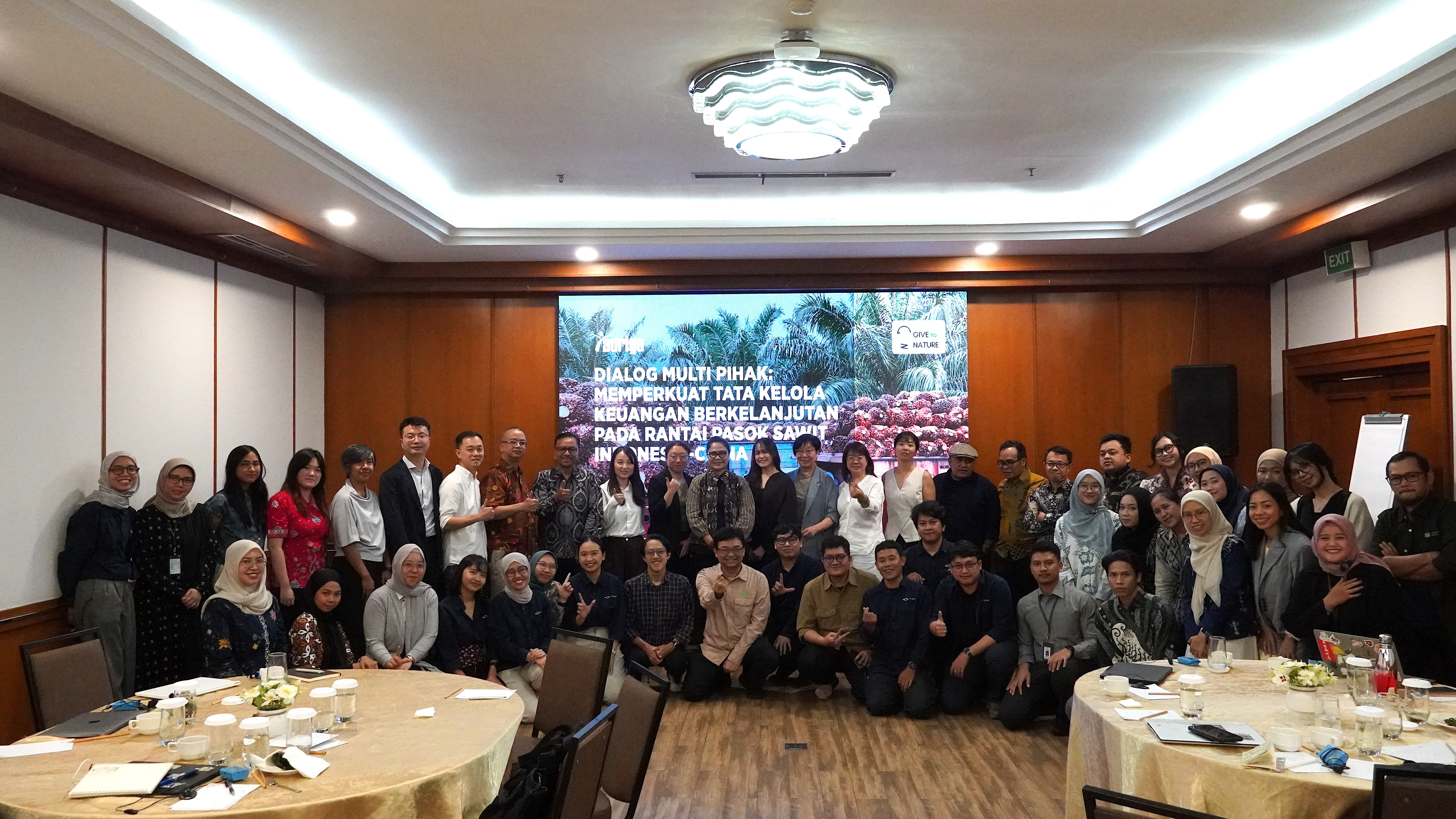
Multi-Stakeholder Dialogue: Strengthening Sustainable Finance in the Indonesia–China Palm Oil Supply Chain
As China's demand for sustainable palm oil grows, gaps between Indonesian and Chinese green finance standards are creating hurdles for banks and risking smallholders' place in the supply chain. Auriga Nusantara and Give to Nature convened regulators, financial institutions, and industry experts in Jakarta to explore how Indonesia's sustainable palm oil data can support stronger Indonesia-China green finance cooperation.
Jakarta, 7 July 2026 – Auriga Nusantara held a multi-stakeholder dialogue entitled Strengthening Sustainable Finance Governance in the Indonesia–China Palm Oil Supply Chain. The dialogue was initiated in response to the evolving trade relationship between Indonesia and China in the plantation sector, particularly given China’s position as one of the major markets for Indonesian palm oil exports. Given that China is one of the main markets for Indonesia’s palm oil exports, this sector must be accompanied by strong, high-integrity sustainable finance governance, especially considering that Indonesia already has a framework in place in the form of the Indonesia Taxonomy for Sustainable Finance (TKBI), issued by the Financial Services Authority (OJK), and Bank Indonesia’s Green Calculator, a tool for measuring greenhouse gas emissions that calculates, monitors, and reports the carbon emissions footprint of economic activities.
Despite the existence of these frameworks and an extraordinary trade volume of US$22.76 billion (non-oil-and-gas exports to China), there remains a lack of interoperability between domestic and international standards. This creates structural barriers for banks, both in conducting due diligence and in allocating green credit portfolios. China, for example, has developed its own green finance standards, such as the Green Bond Endorsed Project Catalogue. As a result, a cross-border taxonomy gap remains, meaning that sustainable natural resource sectors in Indonesia are not yet fully aligned with or accommodated within sustainable finance frameworks. Against this backdrop, Auriga Nusantara, together with Give to Nature (G2N), organized a high-level discussion designed as an inter-institutional and multi-stakeholder policy dialogue to develop concrete steps toward strengthening sustainable finance governance.
“We are seeing a growing tendency in the Chinese market to seek sustainable sources of palm oil. We see this dialogue as a forum that can bridge the various stakeholders,” said Timer Manurung, Executive Director of Auriga Nusantara.
The dialogue is essentially a structured continuation of the meeting held in Xiamen in April 2026. It aims to present research findings as a factual basis for strengthening and addressing gaps in sustainable finance standards developed in Indonesia, while building a shared understanding of regulatory risks and opportunities for sustainable finance across jurisdictions, particularly between Indonesia and China. Research conducted by Auriga Nusantara and G2N, together with a study by the International Institute of Green Finance (IIGF), identified 9,348 transactions worth US$484 billion (equivalent to approximately IDR 8,635 trillion) between 2015 and 2024. During the same period, 5.34 million hectares of forest cover were converted into oil palm plantations between 1990 and 2024. Notably, although the trend of deforestation driven by oil palm has declined, palm oil production has continued to increase. The IIGF study found that only 9.6% of palm oil products in the Chinese market are RSPO-certified, while environmental due diligence at the concession level remains limited among financial institutions with exposure to Indonesian palm oil.
“Without harmonization, smallholders in the palm oil supply chain could easily be overlooked,” said Jingwei Zhang, Co-Founder of G2N.
At this dialogue, Auriga Nusantara invited a range of stakeholders, including TRASE, IIGF, China Customs Brokers Association, RSPO Indonesia, Bank Indonesia, Climate Policy Initiative Indonesia, and ADM Capital’s Impact Director as speakers. The presence of these experts and authorities is expected to help formulate concrete solutions, strengthen regulatory synergies, and drive the creation of harmonized green finance governance standards for the future of a sustainable palm oil supply chain between Indonesia and China.