
Japan-Indonesia Forest Conservation Symposium Calls for Stronger Action on Zero-Deforestation Supply Chains
Held in Tokyo on 22-23 July as a hybrid event, the Japan-Indonesia Forest Conservation Symposium 2026 called for stronger action on zero-deforestation supply chains. Sessions on Pulp & Paper, Palm Oil, Biomass, and Conservation urged Japanese companies to strengthen due diligence beyond first-tier suppliers and back voluntary pledges such as ZDC/NDPE with binding regulation.
TOKYO, 22–23 July 2026 — More than 1,000 participants gathered in Tokyo and online for the Japan-Indonesia Forest Conservation Symposium 2026: The Future of Supply Chains for Zero Deforestation on July 22–23, a two-day hybrid dialogue confronting deforestation linked to Indonesian timber, palm oil, pulp and paper, and biomass exports to Japan.
Held at Tokyo Women’s Plaza and online, the symposium was hosted by Auriga Nusantara, Global Environmental Forum (GEF), Japan Tropical Forest Action Network (JATAN), and Rainforest Action Network (RAN), together with partner organizations from Indonesia and Japan. The symposium drew 175 in-person and 1,093 online participants across four thematic sessions: Pulp & Paper, Palm Oil, Biomass, and Conservation.
Opening the symposium, Saurlin P. Siagian, Commissioner at Indonesia’s National Commission on Human Rights (Komnas HAM), posed the question that framed the entire two days: “What does it mean to build an economic system that rewards those who choose to keep forests standing?” Siagian noted that Indonesia’s 96 million hectares of forest, an area 2.5 times the size of Japan, generates public benefits that markets consistently fail to price, while the costs of its destruction fall disproportionately on vulnerable communities.
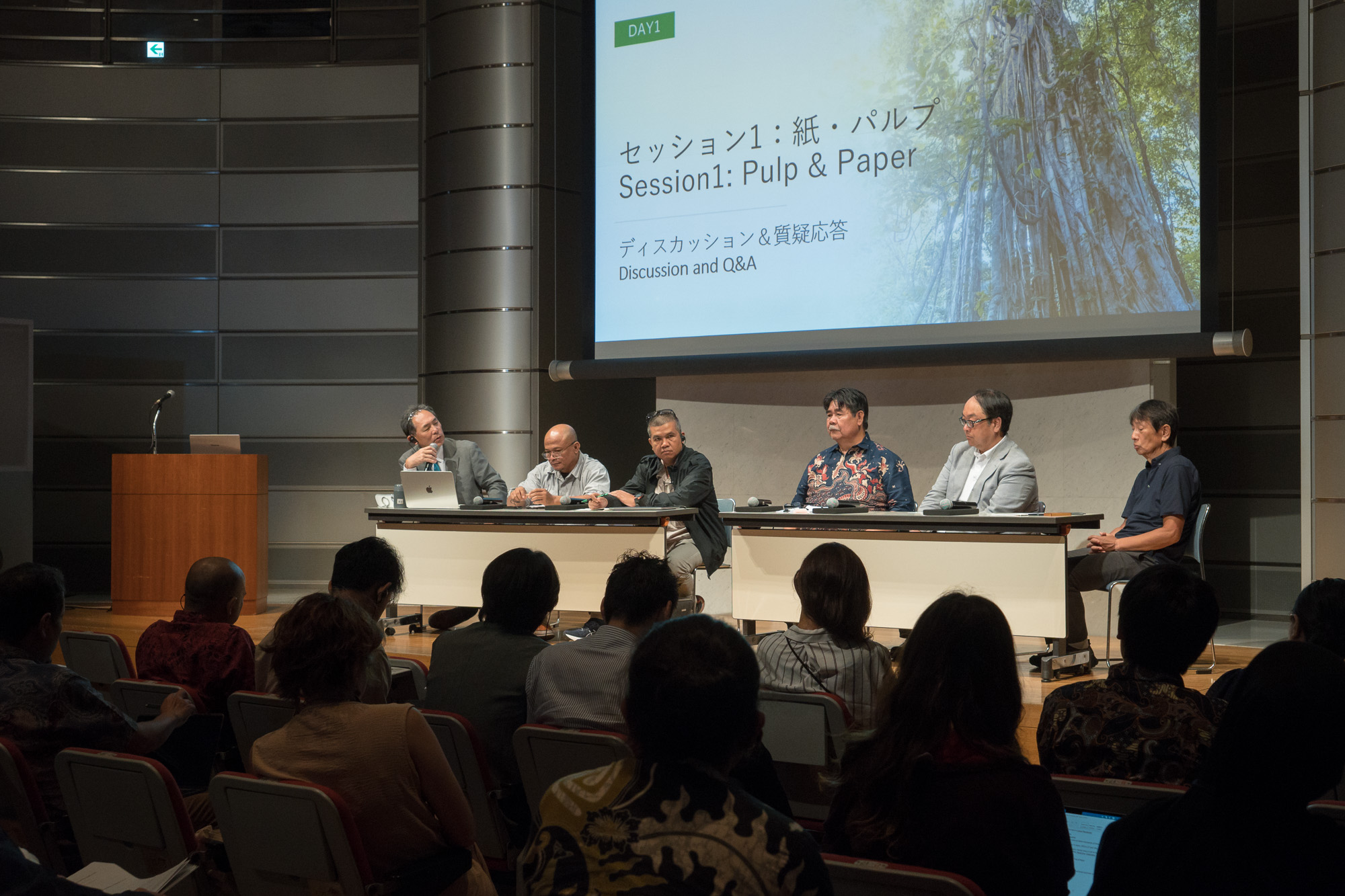
In the pulp and paper session, a sector where roughly 30% of Japan’s copy paper originates in Indonesia, WWF Indonesia and HaKI (Hutan Kita Institute) traced how complex corporate ownership structures blur accountability across the supply chain, and why real remedy has to include recognition and benefit-sharing for communities like Sihaporas in North Sumatra, who are still fighting for their customary land rights. Commentator Prof. Bambang Hero Saharjo warned that forest status “on paper” often diverges from ground conditions, citing 175,400 hectares of net deforestation in 2024. Ajinomoto Co., Inc. agreed: companies should verify their sourcing independently, as legality or certification alone is not a reliable proxy for sustainability.

The symposium brings together NGOs, researchers, Japanese companies, and investors for multi-stakeholder dialogue on zero-deforestation supply chains. © Mighty Earth
In palm oil, supply chain data from TRASE showed that just 14 Indonesian regencies account for over half of Japan-linked deforestation exposure. Meanwhile, named exporter groups already hold zero-deforestation commitments (ZDCs) covering an estimated 85% of Indonesia’s palm oil exports, showing that implementation is now the binding constraint.
“Zero-deforestation commitments are necessary, but implementation needs strengthening.” — Adelina Chandra, TRASE
Building on this finding, JATAN emphasized that voluntary commitments such as NDPE must be backed by effective implementation that goes beyond certification, while LTKL highlighted jurisdictional landscape approaches as a practical model for multi-stakeholder collaboration. Echoing this message, Resona Asset Management stressed that integrating supply chains into landscape approaches requires a step-by-step process, while Kao Corporation shared its efforts to strengthen traceability beyond Tier 1 suppliers, demonstrating how Japanese buyers and investors hold real leverage to close the gap.
Commentator Hidemi Tomita summed up the session’s challenge: even as corporate commitments grow, an estimated 50% of palm oil entering the Japanese market still falls short of sustainability expectations, and real progress depends on making both policy and on-the-ground impact visible.
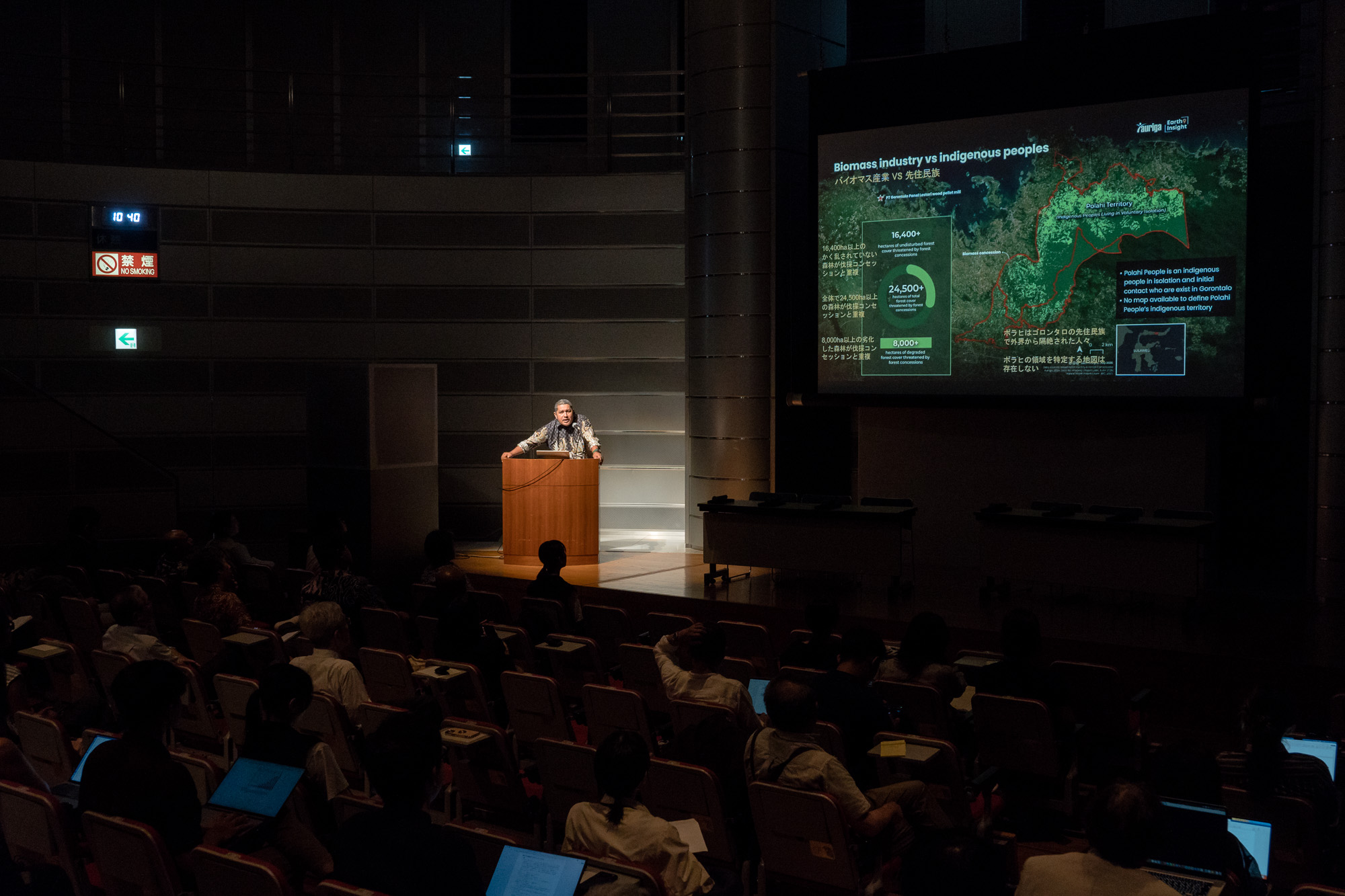
Auriga Nusantara presents on how biomass concessions in Gorontalo threaten the territory of the Polahi people during the Day 2 Biomass session. © Mighty Earth
Moderating the biomass session, Miyuki Tomari of Biomass Industrial Society Network noted that Japan’s own reference standard specifies that forests “shall not be converted to other uses” and that high conservation value land “shall not be converted into plantations”, a standard, she said, that certification has not always managed to enforce. Japan’s Feed-in Tariff system has pressured Indonesia’s forests, especially in Gorontalo on the island of Sulawesi, a key wood pellet export hub.
JAPESDA documented that seven biomass concessions had cleared a combined 14,448 hectares of forest by 2025 and linked the concessions to recurring flooding and unresolved land conflicts. Auriga Nusantara presented mapping showing biomass concessions overlapping with more than 24,500 hectares of forest in the territory of the Polahi, an Indigenous community living in voluntary isolation in Gorontalo whose land has never been formally mapped, including over 16,400 hectares of still-undisturbed forest. Dr. Terri Repi placed those concessions inside the wider Popayato-Paguat landscape, where nearly 70% of mammal species are found nowhere else on Earth, and warned of growing biodiversity threats since the plantations began operating.
“Japan and South Korea should stop subsidizing woody biomass sourced from deforestation.” — Timer Manurung, Auriga Nusantara
On the Japanese side, Sumitomo Mitsui Trust Group called for reliable third-party information sharing, such as data from NGOs to support due diligence, while METI confirmed Japan is revising its biomass sustainability criteria to guard against converting natural forests into plantations. Auriga Nusantara pushed further: legally protect all of Indonesia’s remaining natural forests and stop subsidizing woody biomass sourced from deforestation.
The final session showcased inspiring conservation stories across Indonesia: HUTAN Group in Tanjung Puting (Central Kalimantan), Leuser Conservation Forum or FKL in Leuser (Aceh), and CAN Borneo in Berau (East Kalimantan), alongside Fuji Oil’s landscape approach on the corporate side.
FKL presented a ranger-led program in the Leuser Ecosystem—the only remaining habitat where Sumatran tigers, elephants, rhinos, and orangutans coexist in the wild—as a model for combining protection with local economic development that has restored 5,000 hectares and protected 60,000 more. CAN Borneo brought a parallel case from East Kalimantan, where at least 50 orangutans were rescued from fragmented, unprotected habitat between January 2025 and February 2026 alone. Commentator Prof. Jatna Supriatna placed both efforts in a wider frame: Indonesia holds just 1.3% of the world’s land but a share of its biodiversity rivals Brazil’s, and forests can look intact on a map while suffering what he calls “empty forest syndrome”—forests remain standing but lose much of their wildlife.
Asked who can be the game changer, the speakers agreed: local people, who understand ground realities best, have to lead, and for Japanese companies, that starts with going to production sites and listening directly to communities. HUTAN Group, drawing on the organization’s work in Tanjung Puting, closed the session with a message aimed at Japanese companies:
“Conservation should be built with local communities, based on trust and local knowledge.” — Yuichiro Ishizaki, HUTAN Group
Across all four sessions, speakers converged on a similar set of recommendations: extend due diligence and NDPE commitments beyond first-tier suppliers to mills, plantations, and concessions; match voluntary pledges with binding regulation, noting that Japan has no due diligence law equivalent to the EUDR; design remedy processes that recognize and benefit communities affected by past deforestation; and encourage Japanese companies to engage directly with production sites and local communities rather than relying on certification alone.
Closing the symposium, Dr. Naoki Adachi of Response Ability Inc. said that the two days had shown that deforestation is inseparable from human rights and pressed Japanese companies to judge themselves by results rather than paperwork:
“What matters is not whether certification has been obtained, but how conditions on the ground have changed as a result.” — Naoki Adachi, Response Ability Inc.
He also urged companies to treat the landscape approach—an approach that looks beyond a single company’s own supply chain to an entire region’s forests, watersheds, and communities—not as a practice reserved for a few leading firms, but as the standard for any company sourcing high-risk forest commodities.
The symposium builds on years of civil society engagement between Japan and Indonesia, and organizers said they intend to continue the dialogue as both countries work toward supply chains that no longer drive tropical deforestation.
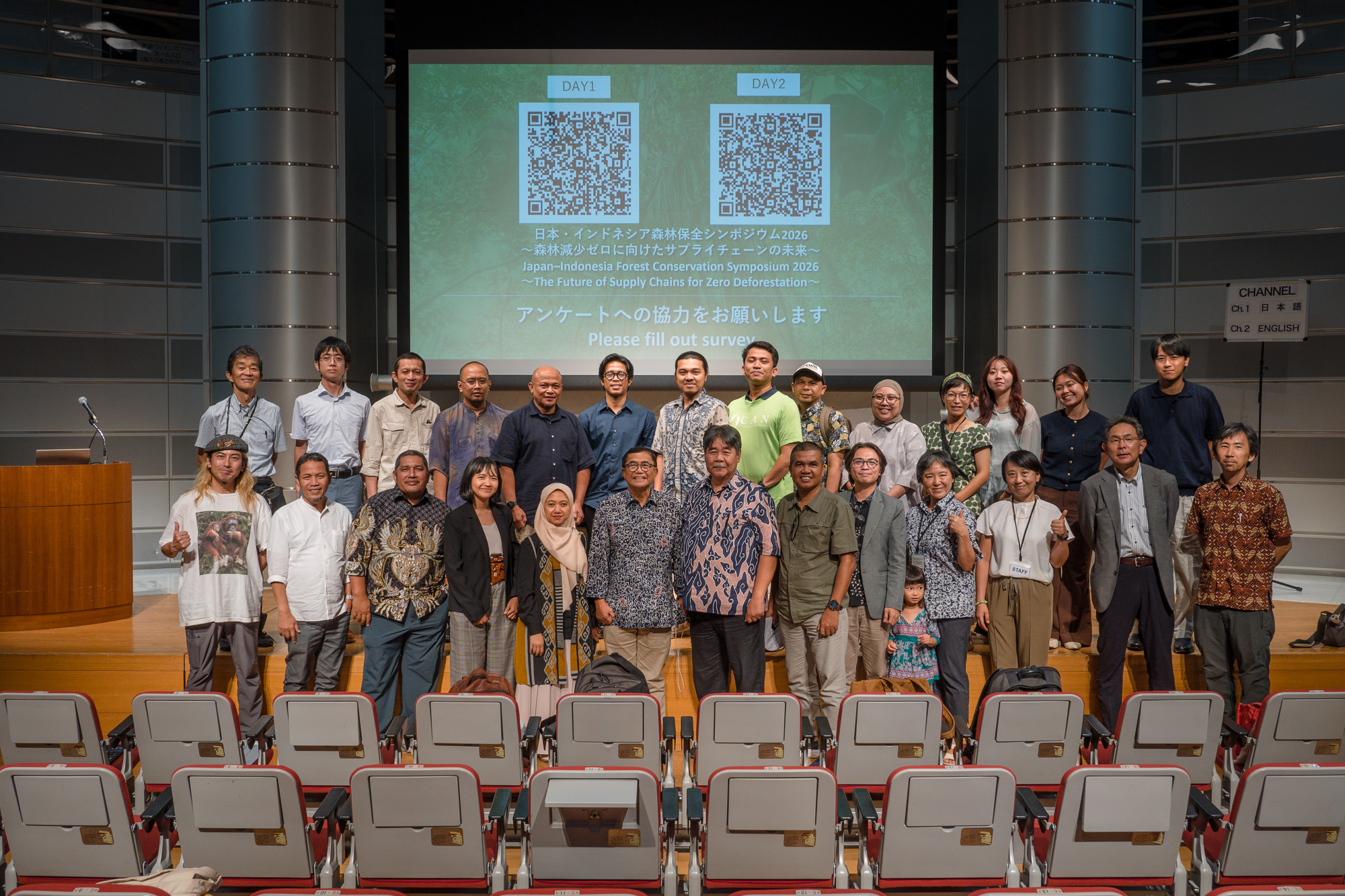
Group photo of speakers, organizers, and some of the participants at the close of the Japan-Indonesia Forest Conservation Symposium 2026 in Tokyo, Japan. © Mighty Earth
The presentation materials can be accessed here.
Media Contact: Global Environmental Forum, Sayoko Iinuma/Katsuhiro Suzushima (event@gef.or.jp), Auriga Nusantara, Anggia Dian Mayana (diplomacy@auriga.or.id)